New study identifies variation in BOAS risk across brachycephalic breeds
Wednesday February 18, 2026
A major new study published on 18 February 2026 in PLOS One has identified significant differences in the prevalence and severity of Brachycephalic Obstructive Airway Syndrome (BOAS) across 14 brachycephalic dog breeds, with Pekingese and Japanese Chins among those most severely affected.
The research, led by Francesca Tomlinson as part of her PhD at the University of Cambridge under the supervision of Professor Jane Ladlow, evaluated 898 dogs and examined conformational risk factors associated with BOAS severity. The study has been selected as a highlighted paper by the journal.
Professor Jane Ladlow is an RCVS and European Specialist in Small Animal Surgery, Partner at Granta Veterinary Specialists, and newly appointed Professor at the University of Cambridge.
Key findings
BOAS is a chronic, conformational airway disorder affecting short-skulled (brachycephalic) breeds. It is associated with exercise intolerance, respiratory noise, heat intolerance and, in severe cases, life-limiting respiratory compromise that may require surgical intervention.
In this cross-sectional study:
- Only 11% of Pekingese were graded free of BOAS, a prevalence comparable to previously published data in Bulldogs.
- Japanese Chins also showed high levels of disease, with just 17.4% graded unaffected.
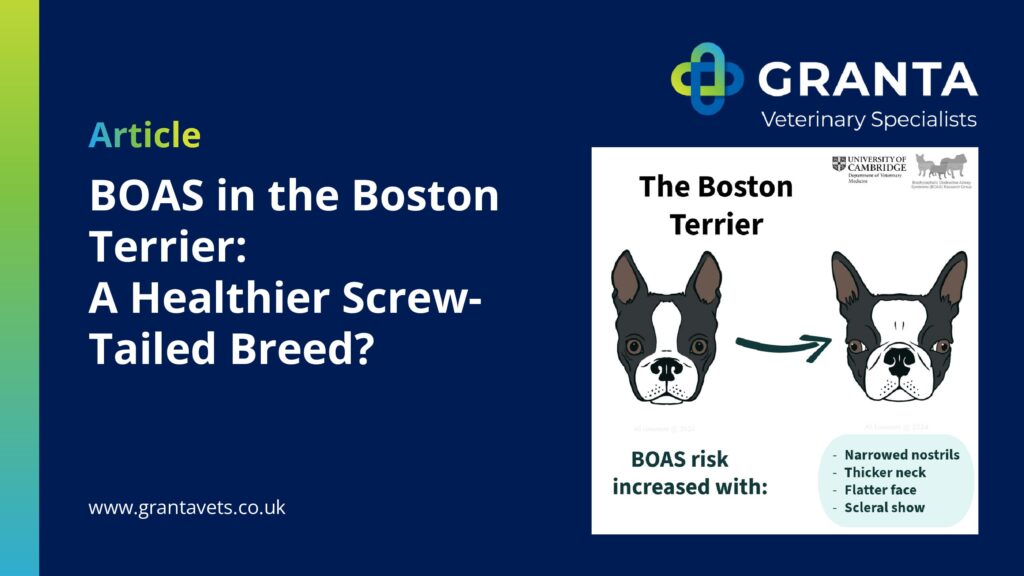
- King Charles Spaniels, Shih Tzus and Boston Terriers demonstrated intermediate risk profiles.
- Cavalier King Charles Spaniels, Pomeranians, Boxers and Chihuahuas had substantially lower proportions of clinically affected dogs.
- Across all breeds, increased facial shortening, dynamic nostril collapse and higher body condition score were significantly associated with BOAS severity.
The findings demonstrate that BOAS risk is not uniform across brachycephalic breeds and that specific conformational traits markedly increase the likelihood of clinically significant airway compromise.
Implications for welfare, breeding and clinical practice
The findings provide objective data to inform breeding decisions and support structured respiratory grading schemes, including those led by The The Royal Kennel Club.
Francesca Tomlinson, lead author of the study, said:
“Our research shows that BOAS varies widely between brachycephalic breeds. By understanding these differences and identifying key risk factors, we can move towards more targeted and effective strategies to improve welfare.”
She added:
“Long-term improvements in dog welfare depend on combining scientific evidence with the commitment of breeders and owners who care deeply about their dogs.”
“This research would not have been possible without the support of dedicated owners and breeders who volunteered their dogs to take part. Their enthusiasm and willingness to engage with health testing highlights how much people care about improving breed health.”
Professor Jane Ladlow commented:
“This study provides important comparative data that supports more evidence-based breeding decisions and clinical guidance. By identifying specific conformational risk factors, we can better advise breeders and owners, and ultimately improve respiratory welfare in these breeds.”
Supporting responsible clinical decision-making
For veterinary professionals, the study provides:
- Updated comparative prevalence data across 14 breeds
- Evidence-based confirmation of key modifiable risk factors, including obesity
- Further justification for early clinical screening and owner education
- Support for structured respiratory grading schemes
As an independent referral centre, Granta Veterinary Specialists continues to support referring practices with evidence-based assessment and management of BOAS, alongside collaborative engagement with breeders and welfare bodies to drive long-term improvements in canine respiratory health.
Publication details
Tomlinson F. et al. (2026). A cross-sectional study into the prevalence and conformational risk factors of BOAS across fourteen brachycephalic dog breeds. PLOS One.
Published 18 February 2026.
https://journals.plos.org/plosone/article?id=10.1371/journal.pone.0340604
For further information, interviews or clinical commentary, please contact:
Professor Jane Ladlow
Partner, Granta Veterinary Specialists
Professor of Small Animal Surgery
University of Cambridge
Also in the news

Cuneiformectomy for Advanced Laryngeal Collapse – What the Latest Evidence Means for Your BOAS Patients

Statement on the CMA’s Investigation into the Veterinary Sector
BOAS in the Boston Terrier: A Healthier Screw-Tailed Breed?