Cardiology
Specialist investigation and management of cardiac disease in small animals

Diagnostics
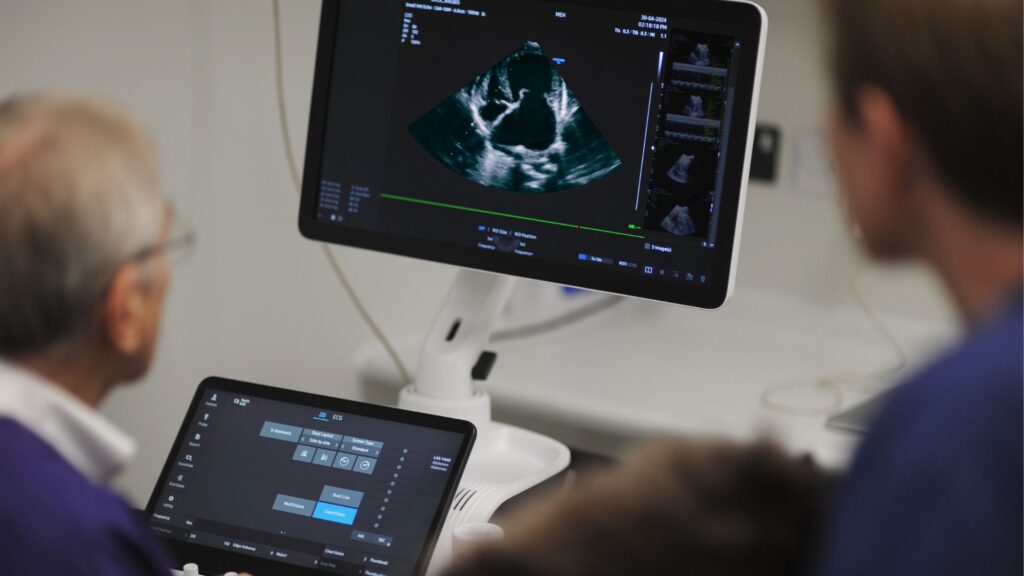
- Echocardiography (2D, colour-flow Doppler, Pulsed-Wave / Continuous-Wave Doppler, Tissue Doppler Imaging)
- 12-lead electrocardiography
- 24-hour ambulatory (Holter) electrocardiography
- Pacemaker implantation
- Temporary external pacemaker placement
- Pacemaker programming
- Fluoroscopy and angiography
- Computed Tomography and CT Angiography
- Digital radiography
- Diagnostic and therapeutic endoscopy
Surgery / treatment
- Permanent pacemaker placement (transvenous and epicardial)
- Balloon valvuloplasty for critical pulmonic stenosis
- Amplatz Canine Ductal Occluder (ACDO) placement for Patent Ductus Arteriosus (PDA)
- Trans-atrial stenting for relief of vena-caval occlusive disease
- DC cardioversion
- Dirofilaria immitis (heartworm) extraction in Vena Caval Syndrome
FAQ’s
- Cardiology problems are initially assessed by a cardiologist asking a number of structured questions in order to determine specific features of an animal’s problem and then to perform a detailed physical examination. Cardiology is a highly physiological subject discipline and we derive vital information about the extent of disease and heart function from ‘hands-on’ examination of things like your pets pulses, heart and respiratory sounds and experience of how these are altered in both disease and normally by other effects on the heart.
- At the end of the consultation with you we will summarise our findings, explain our suspicions and recommendations for investigation and seek to answer any initial questions you may have at this stage (though some may only be answerable after investigation). Most patients will be admitted for an echocardiogram (cardiac ultrasound examination) which will be performed on the same day as the appointment unless something has been identified that would interfere with such an examination. Ultrasound examination requires the clipping of an area of fur from either side of the chest (ultrasound images are interfered with by air trapped in fur), and in virtually all dogs, and the majority (approximately 9 in every 10) cats is performed without sedation. A minority of feline patients require sedation in order to calmly achieve a diagnostic echocardiogram and this is safely performed in patients with cardiac disease of all sorts routinely. Depending on the presenting problem, other tests which may be recommended to perform might include electrocardiography (to assess the heart rhythm for a short period), thoracic radiographs (‘x-rays’) which are performed under sedation, blood tests and ambulatory (Holter) monitoring which is a type of ECG recorder your pet may need to wear at home.
- As a general rule of thumb, if your pet has a heart problem but is not currently showing signs of heart failure (severe illness and debilitation due to the heart disease) then investigation will usually be performed ‘in one go’ as a day-patient being admitted for investigation straight after the appointment. If your animal is showing signs of active illness or is determined to have a respiratory disease, rather than a cardiac one, then it will be recommended to be admitted to the hospital to treat and investigate further.
- The most important information that you can provide is clear reports of your observations at home in answer to the structured questions we will ask you at initial consultation. For this reason it is important that the pet’s caregiver who is able to observe them the most attends the appointment. Please try not to base answers upon anything you may have read on the internet or discussion groups, bearing in mind that these are a frequent source of misinformation and not where anyone with genuine expertise is likely to provide information.
- If your pet has been prescribed cardiac medications then please continue to give these up until the appointment (though do not give your pet a large breakfast if you are in the habit of giving this medication with food – it is permissible to administer tablets with a tiny amount, no more than a morsel, of food if needed), and please bring the medication in its original packaging with you as we will wish to review this.
- If your pet is doing something that creates an unusual noise, has an unusual breathing pattern, falls or ‘faints’, then capturing such episodes on a mobile phone video can be very helpful.
- Lastly it is vitally important that if your pet has had any x-rays taken or any blood tests, that the x-rays and blood test results (not just a print-out of their medical record) are sent to us by your vet in advance of the appointment as this information is not present in their medical file and can completely alter the need for certain investigations; if it is not received by the time of your appointment it may delay investigations.
A cardiac ultrasound examination (echocardiogram) provides invaluable information in assessment of heart disease in pet animals but it is technically demanding to perform requiring training and daily performance to achieve proficiency in, that can only be reached by evaluating cardiology patients only in clinical practice. Furthermore echocardiography is a ‘physiological study’ where we are performing assessments of heart structure and function ‘in real time’. It is not adequate to examine selected images from a recording of an echocardiogram made elsewhere; it would be like attempting to explain the entire plot of a film based on the observations one could make from seeing a clip from the trailer or an image from the advertisement poster.
- In veterinary cardiology we have the benefit of a large number of studies determining the efficacy of different medication types, and, importantly, good information about the circumstances in which medication is not proven to be of benefit to patients. Any treatment recommendations are always based upon this and in many ‘stages’ of heart disease, a recommendation may be given that no treatment is necessary / desirable at this time point, but that a further evaluation at a point in the future would be prudent to evaluate if this recommendation should change. If medication is required, it is likely that this will be needed continuously. We will dispense a supply for usually 3-4 weeks and the recommendation for treatment will be communicated to your vet in the form of a referral report.
- Further medication (either being physically dispensed, or if desired, a written prescription) should be subsequently obtained from your pet’s regular vet. Should any treatment recommendations change, we will communicate this to them in writing.
- Note that it is a regulatory requirement and based soundly on the detection of changes in circumstance that may alter medication need, that in order to provide prescription only medications (POM), the prescribing vet must have physically examined the patient within a period of time (most commonly within 6 months); this is also the case for written prescriptions which are legal documents of governmental regulation. Please ensure that plenty of notice is given when making repeat medication requests especially around public holidays and Christmas time when veterinary practices may be closed except for emergencies.
- The types of investigation that Cardiac patients may require are non-invasive / intrusive and are not uncomfortable or painful and the most commonly performed examination (echocardiography) takes place with gentle re-assuring restraint on a padded mattress in a quiet, darkened room after massaging gel into the skin; most pets are very relaxed for this
- If you are the owner of a dog that has been known to nip or bite in previous examinations please communicate this in advance of us examining (nipped fingers prevent us from being able to work!) and it is best that you bring with you to your appointment a suitably-fitting muzzle to place. You may of course hold and re-assure your pet whilst we perform the physical examination and most dogs are re-assured by this enough to allow adequate performance of this.
- In cats who are combative in nature or where previous examinations at a veterinary surgery have been unsuccessful, we would recommend that prior to the appointment a mild sedative regime is employed which your veterinary surgeon can start the day before the appointment and for which we provide recommendations that will not interfere with subsequent tests. Please contact your regular veterinary surgeon in advance of your appointment at Granta to arrange this.
- It’s common in many long-term cardiac problems that we may need to re-evaluate patients to see if the disease ‘stage’ has changed (for example progressing from a point where medication is unhelpful, to a point where we have good evidence that it is) or to re-assess whether a given therapy is having the effect that we desire / aim or whether adjustment or a change of medication is needed
- Re-assessment examinations are not recommended ‘for the sake of it’ or at a frequency that would result in pets spending more time than is absolutely necessary ‘going to the vets’, and these recommendations are made in the context of the type of disease with which we are dealing, the expected time-course to see progression in most patients, and so that timely adjustments in management can be made if necessary
- Some types of re-assessment (for example if a drug is being used whose effects can be measured on a blood sample) can be performed by your regular veterinary surgeon and we will communicate what needs to be done where and when to both you and your vet
- Other types of assessment are based on experienced assessment of physical examination findings and history from you performed by a cardiologist used to how these findings may change over the course of disease and can’t be substituted for a telephone call or information provided by another party.
- The cost of re-examination appointments and follow-up echocardiograms and other tests performed at Granta Veterinary Specialists is reduced compared with initial tests as part of our continuous follow-up care and it is not necessary to be ‘re-referred’ for continued care of the same condition. Please though ensure that if your pet has required veterinary treatment in the interim that updated clinical records are communicated by your vet
Meet the Specialists

Contact us
Get in touch with the Granta team